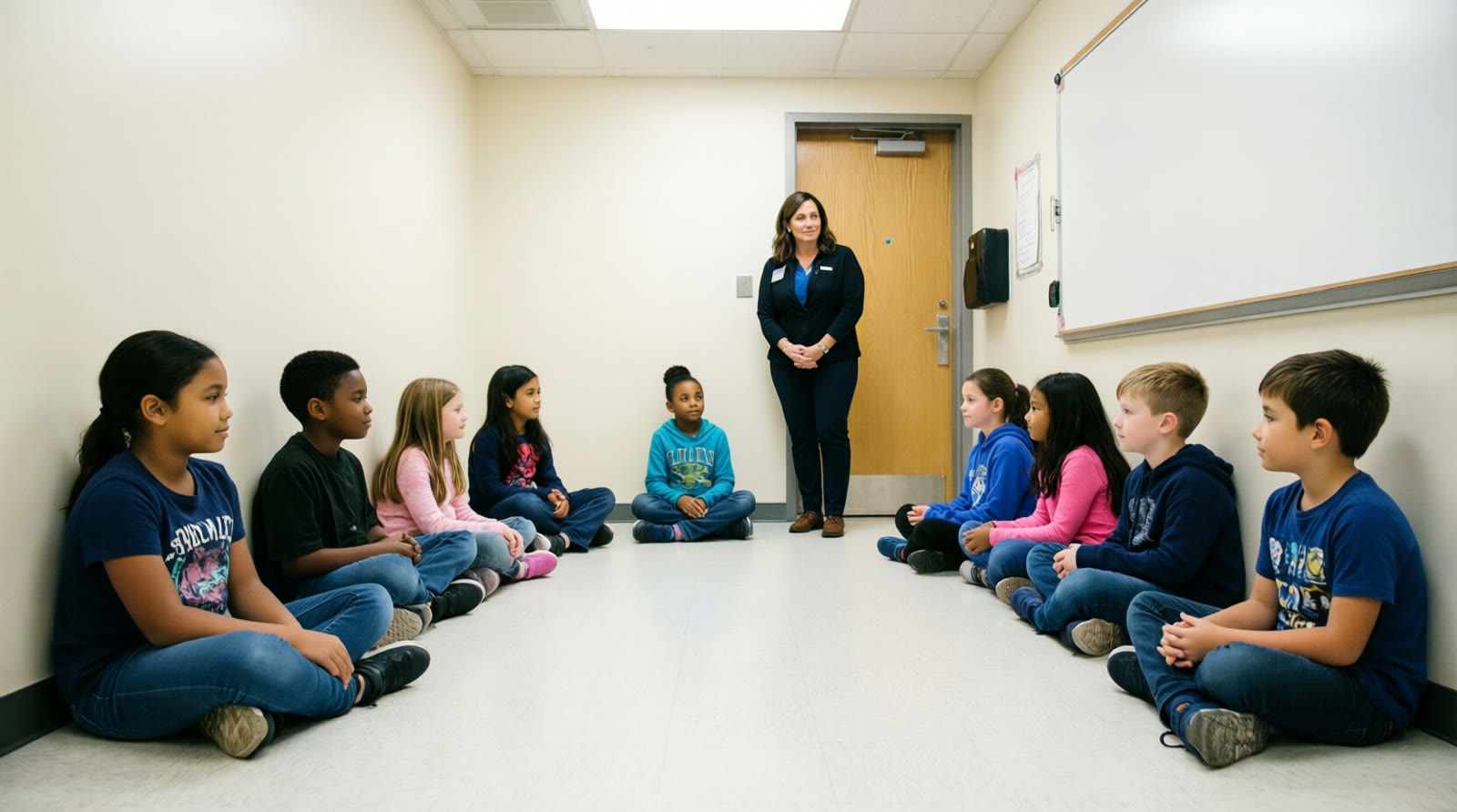
Parents, PTAs and students
Every classroom a safe harbor. It usually starts with one person asking.
A solid door, locked, with everyone inside safe. Districts move on safety when the people they answer to ask clearly and calmly. This page is for the parent, the PTA president and the student council member who want to be that person.
Start here
One question, three ways to help
"Are our classroom doors locked right now, and how do you know?" Most schools answer honestly: it depends on each teacher remembering, every period, every day. That is the gap. Here is how each of you can help close it.
Parents
Ask the question, bring the facts to your principal and board, and ask for a ten‑door pilot. Your district probably already has money it can use.
PTAs, PTOs and foundations
Help fund a pilot wing, or the local match on a grant, working through the district from day one. That is the right home for fundraising.
Students
You are the people the doors protect, and the group adults listen to most on how safety should feel. Your voice is worth more than any bake sale.
For parents
Six steps from a question to a pilot
Ask the principal
Ask the one question, in person or by email. Keep it about the system, not the teachers: they have a hundred things to remember, and a door should not be one of them.
Bring the facts
Share the two‑page board brief and the evidence. Investigators keep finding the same gap: classroom doors left unlocked when it mattered.
Point to the money
Most states now fund school safety per student or per campus, and federal programs name door locks in writing. Paying for this is the district's job, and the budget lines usually exist. Grants and state funds.
Ask for a pilot, not a promise
Ten doors, one wing, one drill. The district gets a door‑by‑door report it can show the board and families, then decides. The 10‑door pilot.
Take it to the board
If the principal is supportive but the decision sits higher, sign up for public comment at a board meeting. Two minutes, one question, one ask: a pilot this year.
Bring other parents
A board hears one parent politely and five parents carefully. Invite your PTA to put it on a meeting agenda; the next section is for them.
For PTAs, PTOs and school foundations
Fund a pilot wing, and do it through the district
Families raise money for playgrounds, laptops and field trips every year. A pilot wing of safe‑harbor classrooms is a project a PTA or foundation can help make happen, as long as the district owns it from the first conversation.
What a pilot costs
About $28,000 in year one for ten existing doors, as a planning figure before any grant: roughly $24,900 for hardware and installation by a local contractor, plus $3,250 for the annual license. Installed cost runs from about $18,500 to $38,000 depending on the doors and cabling. See how the numbers are built.
Three ways to help that work
- Cover the local match on a grant. The federal COPS School Violence Prevention Program asks for a 25% local match. Funds raised by families can turn a district grant application from "maybe next year" into "yes."
- Fund the pilot hardware. A gift toward the ten doors in one wing, given to the district for that purpose.
- Make the case together. Put the pilot on your meeting agenda, invite the principal, and send the district a letter of support. It costs nothing and boards notice it.
Before you raise a dollar
- Talk to the district first. Doors are district property. Any gift goes through the district's gift‑acceptance and purchasing process, and the district chooses the contractor.
- The fire marshal signs off on every door. That review is part of every installation, and it is a good thing to tell donors.
- Settle who pays the license. A gift covers a one‑time cost. The license renews every year, so agree in writing that the district carries it after year one. A gift that leaves a surprise bill is not a gift.
- Give to the district, not to us. ClassLock does not accept donations or run fundraising campaigns for schools. Your money should go to your district, earmarked for the project.
For students
Your voice is the strongest evidence there is
In a 2025 survey, more than 80% of students rated interior door locks both effective and comfortable. Adults deciding school safety rarely hear that from students directly. You can change that.
Pass a student council resolution
A short statement that students want classroom doors locked by default, with no cameras and no detectors, carries real weight with a principal and a board.
Speak at a board meeting
Students can usually sign up for public comment like anyone else. Talk about how a drill feels and what would make the room feel safe. Keep it calm and specific.
Help run the climate survey
Every ClassLock pilot includes a survey before and after, asking how safe and how comfortable school feels. Students can help write the questions and get classmates to answer them.
Write about it
A piece in the school paper or a class project on how other schools handle locked doors helps classmates and parents understand the idea, and raises the questions worth asking. Start with what other districts did.
Want to raise money too? Do it through your PTA, PTO or school foundation, with an adult sponsor and the district's approval, using the steps above. Nobody should feel pressured to pay for their own safety at school. The district's safety budget is the first place this money should come from.
The champion kit
Everything to bring to a meeting, in one download
Three printable pages: a one‑page flyer to share with other families or put in the PTA newsletter, and fill‑in templates for an email to the principal, two minutes of public comment at a board meeting, a PTA letter of support and a student council resolution.
The board brief is the two‑page summary written for principals, superintendents and board members. Bring both.
Editable templates
Copy a template, replace the [bracketed] parts, and send it.
Email to the principal
Two minutes at a school board meeting
PTA or PTO letter of support
Student council resolution
Questions champions ask
Before you start
Can our PTA just buy the locks and donate them?
Not directly. These are electrified locks on district doors, tied into the school schedule and network, and installed by a licensed contractor with a fire marshal's sign‑off. The district has to own the project. What a PTA can do is give money to the district earmarked for it, or cover a grant match.
What if the principal says it is not in the budget?
Ask which budget. Many states fund school safety per student or per campus, and that money can often be used for door hardware. Point them to the funding page, and mention that ClassLock works with grant writers who are paid only if a grant is approved.
Does it help if only one wing has it?
Yes. Every pilot classroom is locked by default from the first day, and the drill report shows the district exactly how those doors performed. Most districts expand wing by wing.
How do I talk about this with younger kids?
Simply. "Our classroom door stays locked during class, like the front door at home, and opens with your badge." There is no need to talk about why. The point of the design is that school feels normal.
Will students be tracked?
ClassLock records that a badge opened a door at a time, like a key log. No video, no biometrics, no location tracking. The district owns the data. Privacy details.
Tell us your school. We'll send you what to bring.
A copy of the board brief, the funding programs for your state, and a pilot outline your principal can act on. If the school wants a call, we will take it.