The evidence
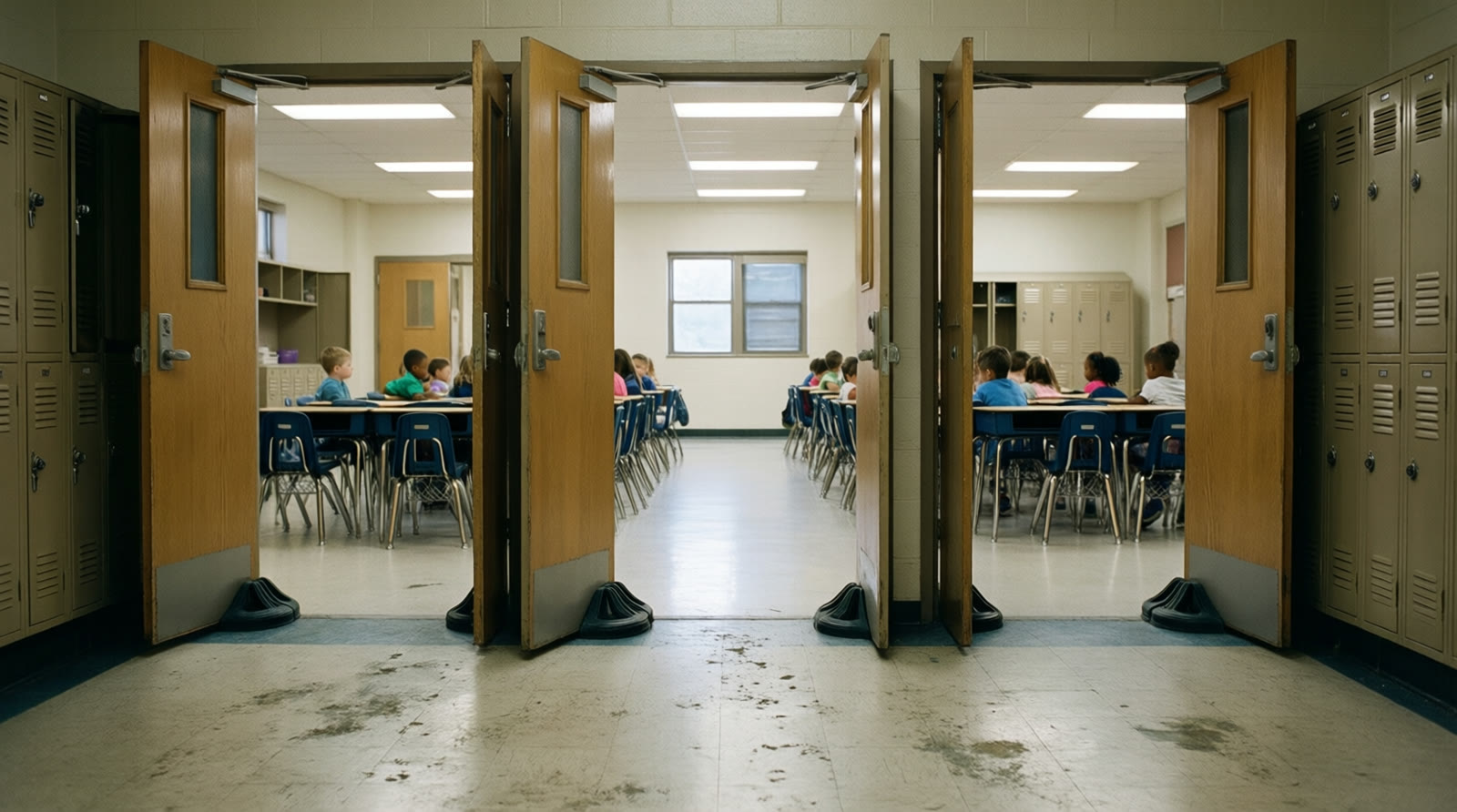
A solid door, locked, with the attacker on the other side. Everyone inside is safe.
That is not a hope. Across every major U.S. school attack since Columbine, no classroom lock was ever defeated. Every death behind a locked or closed classroom door came through glass, never through the lock. This page is about that room: why it was so often missing when it was needed, and how to make sure it is there.
The goal
A classroom as a safe harbor
Four conditions. Each one is something a school can see, check and buy. When all four hold, no attacker in 25 years of U.S. school shootings has gotten through.
1. A solid door
Flush doors with working locks, solid doors without glass, were never breached in the 54 active shooter events ALERRT studied from 2000 to 2025. Every breach ALERRT recorded went through glass.
2. Locked before the first shot
Attacks are over in minutes. The door cannot depend on someone finding a key under fire. ClassLock locks it by default and opens it with a tap for the people who belong there.
3. Glass that holds, or none to reach
The 13 deaths that did happen behind closed doors came through a sidelight, a vision panel or a door window. Film, a narrow lite and a hard corner close that gap.
4. Opens for the roster, not the hallway
Nine in ten attackers are students. A door that opens only for the students scheduled in that room keeps the harbor a harbor during passing time too.
What the record says to do
Each finding is a reason to build the harbor, and a way to build it
| What the investigations found | What it means for the harbor | The fix |
|---|---|---|
| 45 of the 153 deaths in our tally were inside classrooms that were not locked: Sandy Hook, where doors locked only from the hallway with a key, and Uvalde, where room 111’s lock was known to be faulty. | The harbor was there. The door was open. | Lock it by default, with no key, no step and no reliance on habit. This is what ClassLock does. |
| 13 deaths happened behind locked or closed classroom doors. In every case the bullets, or the attacker’s arm, came through glass. | The harbor had a hole in it. | Security film or a narrow vision lite, and a marked hard corner out of the sightline. Hundreds of dollars a door, in the same specification. |
| At Oxford, Covenant, Perry and Evergreen the classroom doors held. Not one person inside a locked room was hurt. At Evergreen the attacker spent three minutes trying doors and gave up. | The harbor works when it is there. | Make sure it is there in every room, every period, with a sensor that reports which doors are actually closed. |
| 83% of attacks end within five minutes. Most begin in hallways, cafeterias and at arrival, when people are outside any room. | Part of the day is spent outside the harbor. | Doors that are already locked make lockdown instant, so the time anyone is exposed is the time it takes to step into a room. Pair it with a panic alert. |
| 62% of the doors attackers met were unlocked or propped open. Investigators at Uvalde found rocks in doors, magnets on latches and a lock reported broken months before. | Habit is the weak point, not hardware. | Take habit out of the loop. A door that locks itself cannot be left unlocked, and a propped door raises an alarm. |
| Behind a secured door, 1 in 6 doors in the ALERRT study saw any casualty. Behind an unsecured door, 1 in 2. | The harbor cuts the odds for everyone inside it. | Count the rooms that are secured right now. That number is the goal, and it should be every room. |
Figures are from the Sandy Hook, Uvalde, Parkland, Oxford, Covenant and Evergreen investigations, the Secret Service study of 41 attacks and the ALERRT study of 54 events. The tally and the incident table are below.
What the authorities say
The commissions, fire marshals and researchers agree
The Commission cannot emphasize enough the importance of this recommendation. The testimony and other evidence presented to the Commission reveals that there has never been an event in which an active shooter breached a locked classroom door.
Sandy Hook Advisory Commission, Final Report, Recommendation No. 1, March 2015. Source (p. 24)
No mechanical breach in the dataset was accomplished by defeating a locking mechanism. In every successful case, the perpetrator bypassed the lock by destroying or shooting through glass. Flush doors with functional locks were never successfully breached.
ALERRT Center, Texas State University, "The Role of Locked Doors and Access Control in School‑Based Active Shooter Events," 54 events, 2000–2025, May 2026. Source (pp. 30–31)
Had school personnel locked the doors as the school's policy required, that could have slowed his progress for a few precious minutes, long enough to receive alerts, hide children, and lock doors; and long enough to give police more opportunity to engage and stop the attacker.
Texas House of Representatives Investigative Committee on the Robb Elementary Shooting, July 2022. Source
Compliance, not hardware, is the most common failure mode. The data consistently show that the gap between having security hardware and using it is one of the most significant vulnerabilities in school safety.
ALERRT Center, 2026. 62% of the doors attackers encountered were unlocked or propped open. Source (p. 28)
All recommend classroom doors that are closed and locked when occupied, lockable without stepping into the hallway, unlockable from outside by authorized people, and always openable from inside.
Where the harbor was missing
50 people were killed inside classrooms whose doors were unlocked or could not be locked from inside: one in three of the 153 deaths.
153 deaths in 62 K‑12 attacks. Where were the victims?
We tallied every death in 62 U.S. K‑12 active shooter events from Columbine (1999) through October 2026: the major attacks, each read against its official investigation, every K‑12 event in the ALERRT Center’s study of 2000 to 2025, and the further events from 1999 and 2025–2026 that meet the FBI’s active shooter definition. Attackers are excluded; Virginia Tech is excluded as higher education. The table below covers the 19 major attacks; every incident, door and source is in the Record, which you can filter and download.
Read the bars as a map. The red bars are rooms that were not locked and people who were not in a room. The amber bars are glass. The green bar is the lock itself, and it has never been the thing that failed. Two deaths could not be placed relative to a door from the sources we read; they are shown in grey and counted on neither side. The figures nest: the 50 are part of the 90%, not a separate measure. 71 + 50 + 13 + 4 = 138 (90%); 7 + 6 = 13 (8%); plus 2 not placed = 153.
Why time is the whole problem
Attacks are over in minutes. The door has to already be locked.
83% end within five minutes
Of 41 targeted K‑12 attacks studied by the Secret Service, 83% lasted five minutes or less, 68% two minutes or less, and 44% ended within one minute. None was ended by police arriving from off campus.
60% end before police arrive
In the FBI's study of 160 active shooter incidents, 69.8% of those with a known duration ended in five minutes or less, and 60% ended before police arrived.
95% are current students
In the Secret Service study, 95% of attackers were current students of the school. They are already inside. The perimeter and the front‑door scanner are behind them.
The human step fails under fire
In a randomized trial with blank gunfire as the stimulus, people trying to secure a classroom door 35 feet away failed with a key‑operated lock 31% of the time, and took over 11 seconds when they succeeded. A push‑button lock failed 5% of the time. A door that is locked by default takes zero seconds and cannot be forgotten.
Martaindale, Sandel & Duron, Journal of Mass Violence Research (2023)
What the investigations found on the ground
- Uvalde: teachers propped exterior doors with rocks, left interior doors unlocked for convenience and used magnets to defeat latches. Room 111's lock "was widely known to be faulty, yet it was not repaired." The Department of Justice found "a culture of complacency regarding locked‑door policies." All 21 people killed were in rooms 111 and 112.
- Sandy Hook: every classroom door locked only from the hallway with a key. The substitute teacher in Room 8 had no keys. Twenty children died in rooms 8 and 10.
- Parkland: locks required a key on the hallway side. The attacker never entered a classroom; every round into a room went through the door or its window. Only 2 of 30 classrooms had a marked hard corner.
- Oxford: doors were locked. The shooter "was unable to actually enter any of the classrooms." The four students killed were in a hallway and a bathroom.
- Evergreen (2025): lockdown 42 seconds after the first shot. The attacker spent three minutes trying doors and could not get back in. The sheriff credited locked doors with preventing many more injuries.
Incident by incident
Were the doors locked? Did the attacker get into a classroom?
Compiled from the official investigation where one exists. K = killed (excluding the attacker), W = wounded by gunfire.
| Incident | K / W | Were the classroom doors locked? (not the building entrance) | Did the attacker get into a locked classroom? | Where the harm happened | Source |
|---|---|---|---|---|---|
| Columbine HS, CO, 1999 | 13 / 20+ | Students locked down and barricaded | No | Outside, hallway, library | Summary |
| Red Lake HS, MN, 2005 | 7 / 7 | First classroom was locked | Yes, by shooting out the glass beside the door and reaching in. A second attempt to shoot a lock failed. | Entrance; inside the breached classroom | ALERRT pp. 31, 61 |
| West Nickel Mines, PA, 2006 | 5 / 5 | One‑room schoolhouse; attacker walked in | n/a | Inside the single room | Summary |
| Sandy Hook ES, CT, 2012 | 26 / 2 | No. Doors locked only from the hallway with a key; substitute had no keys | Entered two unlocked rooms | Hallway; rooms 8 and 10 | State's Attorney |
| Marysville‑Pilchuck HS, WA, 2014 | 4 / 1 | n/a | No | Cafeteria | Summary |
| Aztec HS, NM, 2017 | 2 / 0 | Yes. Attacker shot a door lock and could not get in | No | Bathroom, hallway | ALERRT p. 31 |
| Marjory Stoneman Douglas HS, FL, 2018 | 17 / 17 | Key‑locked from the hallway; status of doors fired on unknown | No. "Never entered a single classroom." All rounds through doors or door windows | Hallways, stairwell; inside rooms through door glass | MSD Commission |
| Santa Fe HS, TX, 2018 | 10 / 13 | Attacker was a student already inside the art rooms | Began inside | Art classrooms and closet | Summary |
| Oxford HS, MI, 2021 | 4 / 7 | Yes | No. "Unable to actually enter any of the classrooms" | Hallway, bathroom; one teacher wounded through an office door | Guidepost report |
| CVPA HS, St. Louis, MO, 2022 | 2 / 4 | Exterior side door locked; classroom door status not described in the police report | Yes. Entered the building by shooting out a door window and reaching in; ALERRT records a locked classroom door breached through its vision light. Police later shot the deadbolt of the room where he barricaded himself; it held | Student shot in the hallway outside the dance hall; teacher in Room 323 | SLMPD report pp. 299–381 · ALERRT p. 30 |
| Robb ES, Uvalde, TX, 2022 | 21 / 17 | No. Lock on room 111 known faulty; exterior and at least 8 interior doors unlocked | Entered unlocked rooms 111/112 | All inside rooms 111/112 | DOJ CIR |
| The Covenant School, TN, 2023 | 6 / 0 | Exterior glass doors shot out; classrooms shut and locked | No occupied classroom | Hallway and stairwell | MNPD summary |
| Perry HS, IA, 2024 | 2 / 6 | Attacker shot a locked door, tried the handle; it held | No | Cafeteria before school | ALERRT p. 31 |
| Apalachee HS, GA, 2024 | 4 / 9 | Shooter's own classroom auto‑locked behind him; a student saw the rifle and did not open | Entered one nearby classroom (door status not established) | That classroom; a teacher at his doorway; hallway | ALERRT p. 17 |
| Abundant Life, Madison, WI, 2024 | 2 / 6 | Attacker was a student at the school; official accounts do not say whether she was already in the study hall or walked in | Not established | Study hall | Summary |
| Antioch HS, Nashville, TN, 2025 | 1 / 1 | n/a | No | Cafeteria | Summary |
| Annunciation, Minneapolis, MN, 2025 | 2 / 27 | Attacker never entered; fired through church windows | No | Church pews | Summary |
| Evergreen HS, CO, 2025 | 0 / 2 | Yes. Lockdown in 42 seconds | No. Tried several doors for 3 minutes and failed | One inside, one outside | Jefferson County Sheriff |
| Westwood Hills ES, VA, 2026 | 0 / 1 | Adult outsider forced entry to the building | No | Staff member wounded; ended in library | VPM |
Virginia Tech (2007), excluded from the K‑12 tally, is the clearest natural experiment: identical unlockable doors; the one room barricaded with a table took seven shots through the door and had zero casualties; the three un‑barricaded rooms had 27 deaths. Virginia Tech Review Panel.
Completing the harbor
What the lock alone does not do, and what finishes the job
- Glass. A lock does not stop bullets. At Parkland, six were killed and thirteen wounded inside classrooms through door windows. At Red Lake and CVPA, attackers reached in through shot‑out glass. Security film, a narrow vision lite and a marked hard corner belong in the same specification as the lock.
- The knock. A manual lock makes the teacher choose between opening to every knock, taping the latch, or relying on the window, which is the one place a locked door has been defeated. How today’s locks work and where they fail.
- The attacker who belongs in the room. No door helps there. The Santa Fe attacker began inside the art complex where he was a student. At Abundant Life the attacker was a student at the school, and official accounts do not establish whether she was already in the study hall when she began. Threat assessment and reporting are the prevention layer.
- Hallways, cafeterias and fields. Forty‑six percent of the deaths in the tally happened in open spaces. The answer is a shorter path to the harbor: doors that are already locked, so lockdown is the time it takes to step inside, and a panic alert that reaches every room at once.
- A critic's view. David Riedman of the K‑12 School Shooting Database argues locked doors have not changed how often attacks involve multiple rooms, and points to Parkland students locked out of rooms. We think the answer to "locked out" is a door that opens for the students who belong there, which is exactly what ClassLock is. Read his analysis.
What ClassLock changes
From "can be locked" to "is locked"
Seventy‑six percent of U.S. public schools now report classrooms that can be locked from inside. The investigations show that "can be" is not the problem. Doors that could be locked were propped, keyed from the hallway, defeated with magnets, or left open because answering the door all day is disruptive.
ClassLock removes the step. Doors are locked by default during class, open with a tap for the students on that period's roster, and never require a teacher to leave the room or find a key. Lockdown comes from the office, a panic alert or a button inside the room, and the door sensor reports which rooms are actually closed.
NCES, Digest table 233.50.
Every investigation ends at a door. Start there.
Primary sources used on this page
- Sandy Hook Advisory Commission, Final Report (March 2015). https://portal.ct.gov/-/media/Malloy-Archive/Sandy-Hook-Advisory-Commission/SHAC_Final_Report_3-6-2015.pdf
- Office of the State's Attorney, Danbury, Report on the Shooting at Sandy Hook Elementary School (Nov 2013). https://portal.ct.gov/-/media/DCJ/SandyHookFinalReportpdf.pdf
- ALERRT Center, Texas State University, The Role of Locked Doors and Access Control in School‑Based Active Shooter Events (May 2026). https://alerrtresearch.org/resources/reports/report_2026_sia_locked_doors.pdf
- U.S. Department of Justice, Critical Incident Review: Active Shooter at Robb Elementary School, Executive Summary (Jan 2024). https://portal.cops.usdoj.gov/resourcecenter/content.ashx/cops-r1143-pub.pdf
- Texas House of Representatives, Investigative Committee on the Robb Elementary Shooting, Interim Report (July 2022). https://house.texas.gov/media/pdf/committees/reports/87interim/Robb-Elementary-Shooting-Report-070722.pdf
- Marjory Stoneman Douglas High School Public Safety Commission, Initial Report (Jan 2019). http://www.fdle.state.fl.us/MSDHS/CommissionReport.pdf
- Guidepost Solutions, Oxford Community Schools Independent Investigation (Oct 2023). https://schoolshooters.info/sites/default/files/FINAL-REPORT-OCS-Investigation.pdf
- Metropolitan Nashville Police Department, Covenant Investigative Case Summary (Apr 2025). https://www.nashville.gov/sites/default/files/2025-04/Covenant_Final_Summary.pdf
- U.S. Secret Service NTAC, Protecting America's Schools (2019). https://www.secretservice.gov/data/protection/ntac/usss-analysis-of-targeted-school-violence.pdf
- FBI, A Study of Active Shooter Incidents in the United States Between 2000 and 2013 (2014). https://www.fbi.gov/file-repository/reports-and-publications/active-shooter-study-2000-2013-1.pdf
- Martaindale, Sandel & Duron, Successfully Securing a Classroom Door in a Lockdown, Journal of Mass Violence Research (2023). https://jmvr.org/2023/07/successfully-securing-a-classroom-door-in-a-lockdown-evaluating-two-types-of-door-locks/
- Jefferson County Sheriff's Office, Evergreen High School update (Sept 2025). https://www.jeffco.us/m/newsflash/Home/Detail/2472
- NCES, Digest of Education Statistics 2023, Table 233.50. https://nces.ed.gov/programs/digest/d23/tables/dt23_233.50.asp
- NASFM, White Paper on Classroom Door Security and Locking Hardware (July 2024). https://lifeboltlocks.com/wp-content/uploads/2024/11/NASFM-2024-School-Door-Locking-Document-Approved-7-28-2024-1.pdf