Codes, listings and the AHJ
The codes already allow this. Here is exactly where.
Fire marshals and building officials have one job on a classroom door: make sure everyone inside can always get out. ClassLock never touches the inside of the door. This page explains the model‑code provisions that permit classroom locking, the listings on the hardware, what the local authority having jurisdiction will ask for, and who installs it.
The classroom‑door provision
Model codes expressly permit locking classroom doors against intruders
Since the 2018 editions, both major U.S. model codes include a specific allowance for locking doors in educational occupancies. The conditions are the design of ClassLock.
International Building Code
2018 IBC §1010.1.4.4, now 2021 and 2024 IBC §1010.2.8, "Locking arrangements in educational occupancies." Doors in Group E and educational Group B occupancies may be locked from inside provided, in paraphrase:
- The door is unlockable from outside with a key or other approved means.
- The door opens from inside with one motion, without a key, tool, special knowledge or effort.
- The locking means does not change the door's egress or fire‑door function.
- Remote locking or unlocking "from an approved location" is explicitly permitted.
The 2027 IBC proposal E57‑24 has been approved and turns this permission into a requirement: classroom doors will have to be lockable from inside.
NFPA 101 Life Safety Code
NFPA 101 §14.2.2.2.4 (new) and §15.2.2.2.4 (existing) educational occupancies. Classroom doors may be locked to prevent unwanted entry when the locking means is approved and, in paraphrase:
- The door can be unlocked from outside with a key or other credential.
- Egress from inside is one releasing motion (existing buildings may be allowed two).
- The locking means is not a barricade device and does not require special knowledge or effort.
- Staff can unlock the door from inside, and the door is lockable from inside without opening it.
NFPA's own commentary states that classroom barricade devices "clearly violate" the Code. NFPA 3000, the active‑shooter standard, requires lockdown plans to rely on doors that remain unlockable from outside with a key or credential.
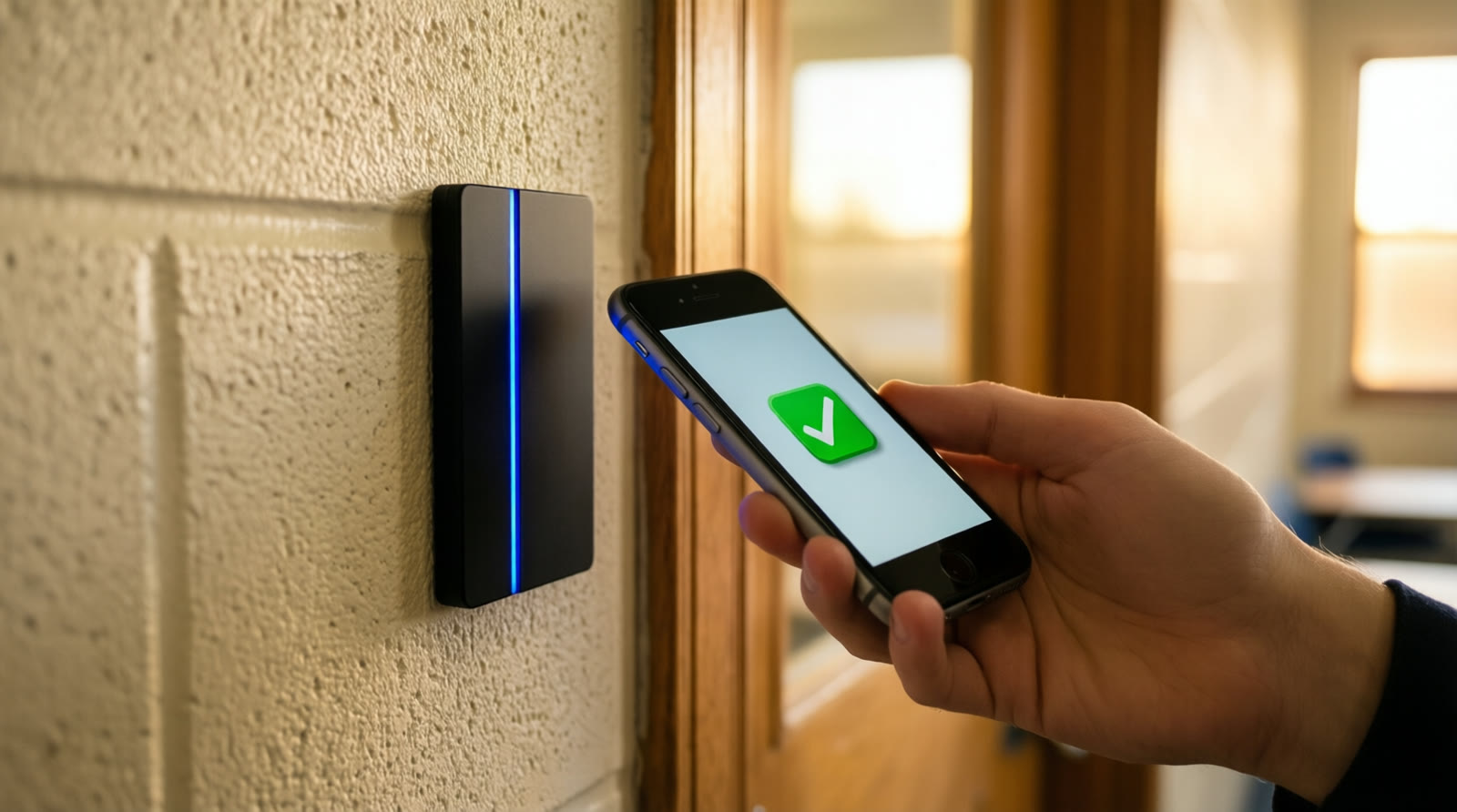
How ClassLock satisfies each condition. Unlockable from outside: by credential at the reader, by the key cylinder already in the lever, and remotely from the office. One‑motion egress: the existing inside lever retracts the latch; ClassLock controls only the strike in the frame. Not a barricade: nothing is added to the inside of the door. Remote locking from an approved location: the admin dashboard and the in‑room lockdown button.
Listings and standards
What the letters on the hardware mean
UL 294
Access Control System Units. The standard AHJs expect to see on access‑control controllers. It evaluates four performance areas: destructive attack, line security, endurance and standby power, each graded Level I to IV. ClassLock runs on UL 294 listed Axis network door controllers. The listing covers the controller that makes the grant‑or‑deny decision; the reader, strike and power supply carry their own listings.
UL 1034
Burglary‑resistant electric locking mechanisms. Static strength, impact and endurance ratings for electric strikes and locks. Grade 1 strikes publish static ratings around 1,500 to 2,000 lbf and million‑cycle endurance. The 2024 IBC accepts a UL 1034 listing as an alternative to UL 294 wherever electrified locking must be listed.
ANSI/BHMA Grade 1
A156.2 and A156.13 (cylindrical and mortise locks), A156.31 (electric strikes), A156.25 (electrified locking). Grade 1 is the top commercial grade. ClassLock specifies Grade 1 strikes matched to the existing Grade 1 lever so the latch, strike and frame work as one assembly.
UL 10C / NFPA 80 fire doors
Many corridor doors are 20‑minute fire doors that must positively latch. Fail‑secure strikes are the only strike type permitted on them because they keep the latch engaged. ClassLock uses fail‑secure strikes by design and never requires fire‑alarm release.
UL 752 ballistic ratings
Levels 1 through 8 rate doors and glazing against specific handgun, rifle and shotgun rounds. Standard school doors, frames and vision lites have no ballistic rating, and ClassLock makes no ballistic claim. Districts that want it can specify UL 752 door assemblies and ClassLock controls them the same way. See the estimator for the cost difference.
ADA
ADA 309.4: operable with one hand, no tight grasping or twisting, 5 lbf maximum. ClassLock does not alter the egress‑side lever, closer force or door surface, so a door that is accessible today stays accessible. ClassLock does not by itself make a non‑compliant door compliant.
Fail‑secure, explained
Loses power: locked from the hall, open from inside. Always.
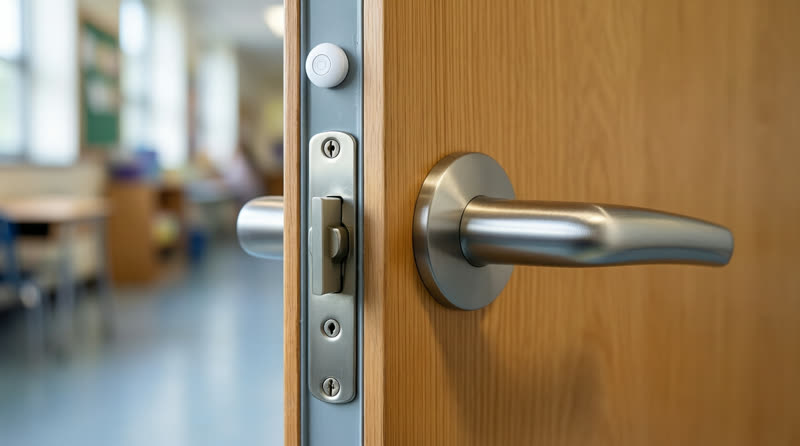
An electric strike sits in the frame and holds the door's latch. A fail‑secure strike holds the latch when it has no power and releases only when energized. ClassLock energizes it for a few seconds on a valid credential. Cut the power, cut the network, pull the controller off the wall, and the door is still locked from the hallway and still opens from inside with the lever.
This is different from a magnetic lock, which is fail‑safe, needs continuous power, must be released by the fire alarm, and can hold people in. ClassLock does not use magnetic locks on classroom doors.
Allegion, fail‑safe vs. fail‑secure · Electric strikes on fire doors
"Can't they just shoot the lock?"
What the record shows
The 2026 ALERRT Center study of 54 school active‑shooter events found that no locking mechanism in the dataset was defeated mechanically. Every successful breach of a secured door went through glass. Flush doors with functional locks were never breached. The Sandy Hook Advisory Commission heard testimony that there had never been an event in which an active shooter breached a locked classroom door, and the National Association of State Fire Marshals restated that in 2024.
A Grade 1 lever and strike are a solid steel latch bolt held by a steel keeper in a steel frame. Gunfire deforms them; it does not reliably retract the latch. The realistic attack is on the vision lite, which is why ClassLock pairs well with security film and small or narrow lites, and why door position sensors tell the office when a door is opened without a credential.
The AHJ process
How a classroom‑door project gets approved
The authority having jurisdiction is usually the local fire marshal or building official, sometimes the state fire marshal, and in some states a school‑facilities office. Approval is per door, per jurisdiction. Here is what the process typically looks like and what ClassLock provides for it.
Door survey
Your installer walks every opening: swing, fire rating, frame material, existing lock, lite size, cabling path. Produces a door schedule.
Submittal
Door schedule, hardware cut sheets with listings, the fail‑secure declaration, an egress compliance letter citing IBC 1010.2.8 and NFPA 101 14.2.2.2.4, and the network diagram.
Plan review and permit
Building and electrical permits for low‑voltage work as your jurisdiction requires. Fire‑rated doors are checked for positive latching.
Installation
Your licensed local contractor installs strikes, readers, sensors and controllers and commissions each door against the schedule.
Inspection
The AHJ checks egress at every door, confirms fail‑secure behavior with power removed, and reviews the lockdown and responder‑override procedure.
ClassLock supplies the submittal package, the compliance letter template and the commissioning checklist. Ohio's 2024 Childhood Safety Act now requires annual inspection of classroom door assemblies; ClassLock's door‑position logs document that every door latched and locked, every day.

Who installs it
Your local door and access‑control contractors
Every component is standard commercial door hardware and standard IP access‑control equipment. The people who already maintain your doors can install ClassLock: architectural door‑hardware distributors, locksmiths, licensed low‑voltage and alarm contractors, and security integrators. Roughly half of U.S. states license these trades at the state level; we help you confirm the right license for your state.
ClassLock trains and certifies installers on the door‑signal model, commissioning and the AHJ package. There is no proprietary installer network and no waiting list for a factory crew.
Industry guidance
What the safety organizations recommend
- PASS (Partner Alliance for Safer Schools) Tier 1: classroom doors "should remain closed and locked when occupied," with keyed or electronic access from the corridor side. Its highest tier describes networked electronic locking initiated remotely or by the teacher.
- National Association of State Fire Marshals, Door Security & Safety Foundation, Security Industry Association: all oppose barricade devices and endorse code‑compliant locks unlockable from outside by authorized persons.
- A fair note on electric strikes. PASS's 2017 guidance cautioned against electric strikes for remote release because a misaligned installation can be defeated. ClassLock addresses this directly: Grade 1 preload‑tolerant strikes, alignment verified at commissioning, and a door position sensor that reports any door that is not latched.
State rules that matter
Jurisdictions with classroom‑door language
| State | Rule | Effect |
|---|---|---|
| Florida | F.S. 1006.07(6)(f) | Classrooms must be locked to prevent ingress when occupied, except between periods or when actively staffed. Temporary locking devices allowed only in an active‑assailant event. |
| Utah | Admin. Code R698‑13‑6 | Classrooms must be locked when occupied by students, except between class periods; magnets that defeat locks are banned. |
| Texas | 19 TAC §61.1031, renumbered §103.1215 (Sept 2026) | Exterior doors closed, latched and locked with weekly inspections and state audits. No interior classroom mandate; the same discipline applied inside is the natural next step. |
| California | Ed. Code §17075.50 | Inside‑lockable classroom doors required in new construction since 2011 and in bond‑funded modernization since 2016. |
| Tennessee | Public Chapter 367 (2023) | Inside‑lockable classroom doors in buildings built or remodeled after July 1, 2023. |
| Ohio | Childhood Safety Act (2024) | Annual inspection of classroom door assemblies; temporary locking devices only per fire marshal rules. |
| Virginia | Emergency supplemental hardware rule | Allows certain supplemental locking in emergencies within defined limits; AHJ review applies. |
Approval is always local. ClassLock does not "meet code" nationally; each installation is reviewed and approved by the AHJ for that building. We build the package that makes that review straightforward.
Bring your fire marshal to the first call.
We would rather answer the egress questions on day one. We will walk through the hardware, the listings and the submittal package together.