Schools, teachers and families
The one security measure students, parents and teachers all say they're comfortable with.
Metal detectors and cameras make kids feel watched. Interior door locks are different: in a 2025 survey of more than a thousand students, parents and staff, more than 80% of every group rated them both effective and comfortable. Here is what the research and the people in the buildings say.
Has this been done before?
Yes. Districts already lock classroom doors by schedule. Their goals were operational. Ours is the same, done everywhere.
Electronic locks on classroom doors are not experimental. What has been missing is a product built for the classroom door specifically, priced for every door, and driven by the master schedule instead of a security office.
Andrews ISD, Texas
Runs classroom doors on a schedule: "Doors are locked when class is in session, then unlocked during the passing period." A one‑tap lockdown "will override all door schedules, lock down all buildings, and secure the entire campus in seconds." Late arrivals without a badge are admitted by intercom and camera.
Iredell‑Statesville Schools, North Carolina
Networked classroom access control "remove[s] the pressure for staff to lock each classroom door individually." Door‑event resolution dropped from about an hour to ten minutes.
Broward County, Florida
After Parkland, where teachers were killed trying to lock doors from the hallway, every Broward school now has classroom doors that lock automatically, and Florida law requires classrooms to be locked when occupied.
Washington Township, New Jersey
Wireless electronic classroom locks on a central system, chosen because "you can't always count on someone releasing the dogging mechanism on the door. Things happen. Teachers may be diverted to something else and a door is left open."
Mountain View‑Los Altos, California
"Even with preparation, people in an emergency may panic and forget procedures. Having tools that reinforce safety protocols are a necessity." Locks blink on the inside so a teacher "can be certain that door is locked."
What these deployments did not measure
Every reported outcome is operational: lockdown time, door‑event resolution, key control, cost. None measured how students or families felt. We will. ClassLock pilots include a before‑and‑after climate survey, because a system that makes kids feel like prisoners has failed even if the doors work.
The research on how people feel
Locks reassure. Surveillance unsettles.
Sources: Byrd et al. (2025); Gallup; Pew via Chalkbeat.
Studies of metal detectors, cameras and guards keep finding the same thing: they are associated with students feeling less safe, and the National Association of School Psychologists cautions against over‑emphasizing "extreme physical security measures." One student in an ACT survey put it plainly: "Putting extra security on children just makes us feel constantly watched, uncomfortable and it feels like punishment."
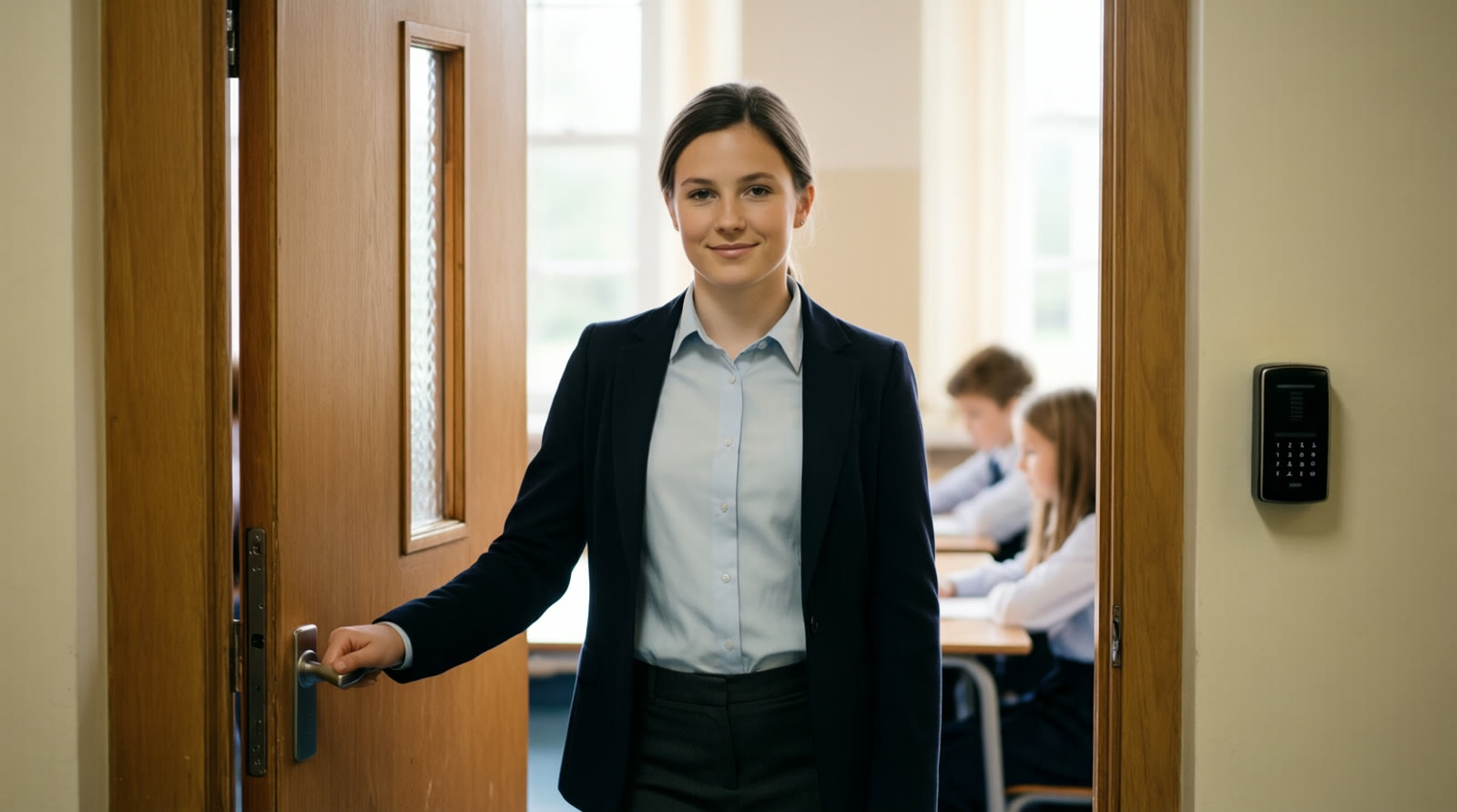
Interior door locks sit on the other side of that line. They are invisible during the day. There is no line to stand in, no bag to open, no camera deciding whether you look dangerous. ClassLock is built to stay on that side: no cameras, no detectors, no AI, just a door that opens for the people who belong there.
NASP research summary · ACT, Physical Safety in Schools (2018)
In their words
Teachers, students, parents and investigators
The Commission cannot emphasize enough the importance of this recommendation. The testimony and other evidence presented to the Commission reveals that there has never been an event in which an active shooter breached a locked classroom door.
Sandy Hook Advisory Commission, Final Report, 2015. Source
Had school personnel locked the doors as the school's policy required, that could have slowed his progress for a few precious minutes, long enough to receive alerts, hide children, and lock doors; and long enough to give police more opportunity to engage and stop the attacker.
Texas House Investigative Committee on the Robb Elementary shooting, 2022. Source
We locked the doors, there's this closet in the classroom, so it was very safe in the classroom, in the back corner.
Savannah, 17, student at Oxford High School, Michigan, 2021. Source
That's when we realized that our classroom door was still open.
Stephanie Reyna, student at Apalachee High School, Georgia, 2024. Source
I am so blessed that Mr. Phenix was still able to get that door shut. He saved my baby.
Nicole Biondi, parent, Apalachee High School, on a teacher shot while closing his classroom door. Source
Stepping outside the classroom to lock a door during a shooting is "crazy."
Randi Weingarten, President, American Federation of Teachers, on Uvalde. Source
A locked door, whether it's interior or exterior, creates time barriers, and a time barrier can save lives.
Dr. Kathy Martinez‑Prather, Director, Texas School Safety Center. Source
Compliance, not hardware, is the most common failure mode. The data consistently show that the gap between having security hardware and using it is one of the most significant vulnerabilities in school safety.
ALERRT Center, Texas State University, Locked Doors study, 2026. Source
Quotes are reproduced from the linked public sources. None of these people has endorsed ClassLock.
Who supports locked classroom doors
Parents' groups, teachers' unions, fire marshals and the security industry agree on this one.
Everytown, Moms Demand Action, AFT and NEA
Jointly endorse "access control and internal door locks" as "basic security measures universally recommended by school safety experts," while insisting "schools cannot become fortresses or prisons." Report
Safe and Sound Schools
Founded by Sandy Hook parent Michele Gay. Teaches code‑compliant classroom security and warns against barricade devices. Site
PASS, NASFM, DSSF, SIA
The school‑safety, fire‑marshal, door‑industry and security‑industry bodies all recommend classroom doors "closed and locked when occupied," with authorized entry from outside and free egress. PASS whitepaper
Make Our Schools Safe
The Alhadeff family's campaign for Alyssa's Law panic alerts, now in 13 states. ClassLock takes those alerts as a lockdown trigger. Site
Objections, answered honestly
What people worry about, and what we do about it
Won't students get locked out: late arrivals, bathroom returns, nurse visits?
With mechanical locks, yes, and it is the documented reason teachers prop doors open. ClassLock is built to fix exactly this. A student who belongs in that room at that time taps in and the lesson continues. A student without a badge is admitted by the teacher, as today, or by intercom and remote unlock from the office. The door closes and relocks behind them.
Doesn't a locked door all day make school feel like a prison?
The research says the prison feeling comes from visible, surveillance‑type measures: detectors, cameras, guards, bag checks. Interior door locks are the measure more than 80% of students say they are comfortable with. ClassLock has no cameras, no detectors and no lines. We also measure it: every pilot includes a climate survey before and after.
Can a student lock a teacher out, or lock others in?
No. The inside lever always opens the door; nobody can be locked in. Teachers, administrators and responders have credentials that open every door they are assigned. Locking is not something a student can do or undo.
Is it a fire hazard?
No. Egress is unchanged and mechanical. ClassLock only controls the hallway side, which is exactly what the building and life‑safety codes allow. The local fire marshal reviews and inspects every installation. Codes and the AHJ process.
Isn't this just more hardening instead of fixing root causes?
Physical measures are necessary and not sufficient. Threat assessment, reporting and mental‑health support prevent attacks; a locked door limits harm when prevention fails. ClassLock is meant to be the quiet layer that lets a school spend its attention and its money on climate and prevention.
Is this being pushed harder on some schools than others?
Researchers have found that locked doors and restroom restrictions are reported more often by students in schools with higher Black and Hispanic enrollment, usually alongside heavier surveillance. ClassLock's answer is that the same quiet, no‑camera layer should be on every classroom door in every school, and that it should replace heavier measures rather than add to them.
Will my child's data be tracked?
ClassLock records that a credential opened a door at a time, the same thing a key log would. No video, no biometrics, no location tracking beyond door events. The district owns the data and sets retention. Privacy details.
Badges are already normal
Your kids probably carry one today.
About 28% of U.S. students ages 12 to 18 report that their school requires a student ID badge, and nearly all schools badge staff and visitors. Dallas ISD now requires every PreK‑12 student to wear one, for identification, bus boarding, library and cafeteria use. Many districts already scan badges for attendance and tardies. ClassLock uses the badge students already have.
Parents: ask your school one question.
"Are our classroom doors locked right now, and how do you know?" If the answer depends on a teacher remembering, send them here.