Compare
Evolv alternatives: what districts switched to, and what it cost them
After the FTC's 2024 action and a string of missed weapons, districts have been asking what else the scanner budget could buy. Here are the four answers we have seen in board minutes and news reports, with sources, plus the one that is not a scanner at all.
Why districts are looking
The record on AI weapons scanners
The FTC action
In November 2024 the FTC charged that Evolv falsely advertised that its scanners detect all weapons, ignore harmless items, and cut labor costs by 70% versus metal detectors. K‑12 customers who signed between April 2022 and June 2023 were allowed to cancel. There was no fine and no admission.
What testing found
In a test obtained by IPVM and reported with the BBC, the scanner missed large knives in 42% of walkthroughs and detected micro‑compact pistols 92% of the time. Evolv's own executive said in 2025 that some bladed weapons will not be detected.
What it costs to run
Leases run about $1,650 to $3,200 per unit per month on four‑year terms, and the screeners cost more than the lease: Granite District in Utah pays $250,000 a year in contracted staff against a $280,000 four‑year lease at one high school.
The alternatives
Four things districts did instead
| Alternative | Who did it | What it costs | What it catches and misses |
|---|---|---|---|
| Buy passive ferromagnetic portals outright (CEIA OpenGate) | Clarksville‑Montgomery County, TN dropped its Evolv lease in 2026 for units bought at $15,000 to $20,000 each. Newport News, VA bought 90 for $1.5M. Kenosha, WI bought 18 plus wands for about $473,000. | One‑time purchase, no lease. Staffing is the same as any screened lane. | Catches ferrous metal at a staffed lane. CEIA's own representative says it is not meant to keep everything out, and it struggles with small handguns and knives in school configurations. |
| Conventional walk‑through metal detectors plus wands and bag checks | Utica, NY replaced its scanners at the high school after a student carried a large knife through one and stabbed a classmate; 10 detectors cost about $250,000. | $1,500 to $25,000 per unit. Labor dominates. The full cost picture. | Near 100% on the pistols the AI scanner caught 92% of the time, but only at the lane that is staffed, and only while it is staffed. |
| AI gun‑detection cameras (ZeroEyes, Omnilert) | Nashville paid more than $1 million for Omnilert; Loudoun County, VA signed a $1.1M‑per‑year Volt AI deal. | $168 to $592 per camera per year on published ZeroEyes contracts. | Alerts a human when a drawn, visible gun is in a camera's view. Did not alert at Antioch High School in 2025, where the district and vendor say the shooter was outside the cameras' effective view. No vendor publishes an accuracy rate. |
| Keep the scanners, cut the hours | Salt Lake City stopped funding contracted screeners and runs its units only at one high school with school staff. Prince William County, VA screens at morning arrival with early‑arriving staff on stipends. | Lease continues; staffing drops to arrival only. | Nothing is screened after first period, or at any door that is not the main entrance. |
Sources: WSMV (Clarksville), The 74 (Newport News), Kenosha County Eye, The Intercept and WIBX (Utica), FOX 17 and WJLA (cameras), KSL and Prince William Times (hours). Full list on the Compare page.
The fifth option
Spend it on the doors instead
Every alternative above is still a detector: it tells you a weapon may be present, at one entrance, during staffed hours. It does nothing for a student who is already inside, which is nine in ten attackers, and nothing for the forty classroom doors behind the scanner.
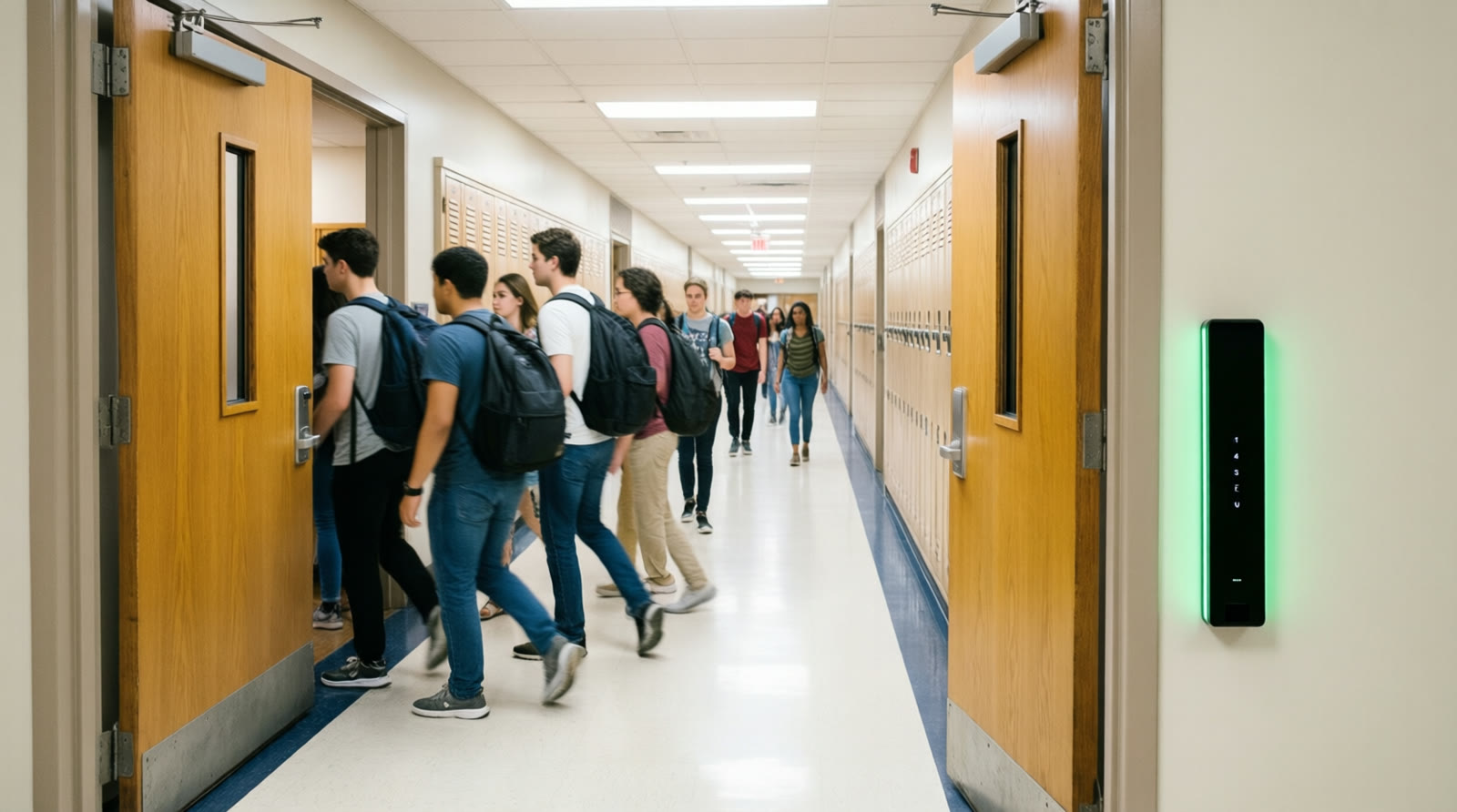
A locked classroom door is a different kind of measure. It does not need to know what someone is carrying. Across every major U.S. school attack since Columbine, no classroom lock was ever defeated. Every breach of a locked door went through glass. ClassLock keeps those doors locked by default and opens them for the people scheduled in the room.
For a 1,500‑student high school, sixty ClassLock doors cost about $239,000 over five years. Four leased scanners with screeners all day cost about $1.64 million over the same period. See the year‑by‑year chart.
Honest limits
- ClassLock does not detect weapons and does not replace threat assessment or reporting.
- It does not cover cafeterias, hallways, gyms or fields.
- It is a new product with no incident record; the evidence is for locked doors, and pilot drill data will be published as districts allow.