Compare
Detection tells you there is a problem. A locked door stops it.
Schools are spending millions on systems that try to spot a weapon. Most of those systems have missed real weapons in real schools, slow every student down every morning, and still leave every classroom door open. Here is the record, with sources, and what it costs. The goal is a safe harbor in every classroom: a solid door, locked, with the attacker on the other side. None of the systems below builds one.
Side by side
What each approach actually does
| Approach | What it stops | What it misses | Typical cost | Staffing | Student experience | Privacy |
|---|---|---|---|---|---|---|
| AI weapons scanners (Evolv Express and similar) |
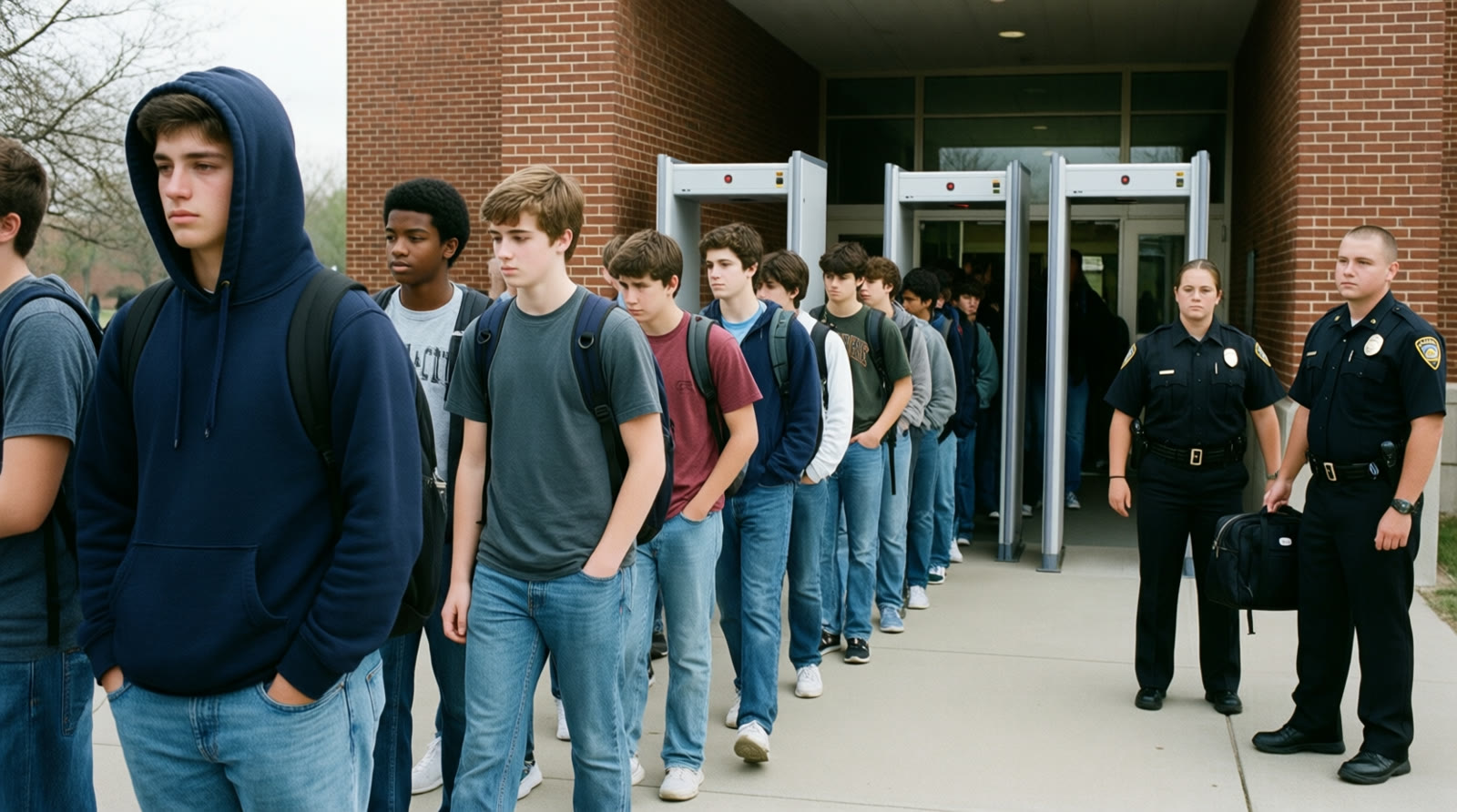
Some concealed firearms, at a screened entrance, during screening hours | Large knives missed 42% of the time in independent testing; micro‑compact pistols 8%; anything through an unscreened door or after screening ends | Lease, about $1,650 to $3,200 per unit per month on 4‑year terms; district contracts of $2.5M to $20M | A screener at every lane plus secondary search; one district budgets $250,000 a year in screeners for one school | Lines; laptops carried in hand; binders banned; 30% of entries alarm in one city | Body scan with camera image; facial recognition options |
| AI gun‑detection cameras (ZeroEyes, Omnilert, Volt) |
Nothing physically. Alerts a human when a drawn, visible gun is inside a camera's view | Concealed guns; guns outside camera view or too far away; knives; everything before the weapon is drawn | $168 to $592 per camera per year; $1M+ district‑wide deals | Vendor operations center plus the school's own response | None at entry | Continuous AI analysis of every camera feed; a Doritos bag triggered armed police on a student |
| Walk‑through metal detectors | Metallic weapons at a staffed lane | Side doors, propped doors, non‑metallic weapons, anything after screening ends | $1,500 to $25,000 per unit; labor dominates | Two or more staff per lane plus bag check | Lines at arrival; bag searches; lower perceived safety in studies | Bag searches; visible policing |
| School resource officers | Fights and some non‑gun violence; response after an attack starts | Attacks are mostly over in under five minutes; one officer, one location | $77,000 to $168,000 per officer per year | The officer | Neutral to negative; higher suspensions and arrests in studies | Low |
| Panic buttons (Alyssa's Law systems) |
Nothing physically. Speeds notification and lockdown orders | Any door that is still unlocked when the alert goes out | Subscription; grants often cover it | None | None | Low |
| ClassLock schedule‑aware classroom access control |
Entry into any classroom by anyone not credentialed and scheduled for it, all day, with no staff action | Does not detect weapons; does not cover hallways, cafeterias or outdoor areas; does not stop an attacker already inside a room | About $2,200 per door installed, one time, plus $250 to $400 per door per year. Estimator | None at the door. IT and facilities administer it. | Tap a badge; no lines, no searches | No cameras, no AI, no biometrics. Credential and schedule data only. |
Shorter reads: Evolv alternatives and what metal detectors really cost. Figures and findings are drawn from the sources listed at the bottom of this page. ClassLock complements threat assessment, reporting and panic alerts; it does not replace them.
The record
AI weapons detection: what the FTC, the tests and the incidents show
The FTC action, November 2024
The Federal Trade Commission charged that Evolv falsely advertised that its scanners detect all weapons, ignore harmless items, and cut labor costs by 70% compared with metal detectors. The Commission vote was 5 to 0. The order lets K‑12 schools that signed between April 2022 and June 2023 cancel their contracts. There was no monetary penalty and no admission.
Utica, New York, October 2022
A student walked through an Evolv scanner at Proctor High School carrying a large knife that was not detected and stabbed a classmate. The district replaced the scanners at the high school with conventional metal detectors.
Antioch High School, Nashville, January 2025
A student shot and killed a classmate in the cafeteria. The school's camera‑based AI gun‑detection system did not alert; the district and the vendor say the shooter was outside the cameras' effective view. The school had no metal detectors. Weapons scanners were installed only after the shooting. A lawsuit over the system's disclosed limits was filed in 2026 and is unresolved.
Independent testing
In a test obtained by IPVM and reported with the BBC, the scanner failed to detect large knives in 42% of walkthroughs and detected micro‑compact pistols 92% of the time. IPVM
False alarms at scale
- New York City's 2024 subway pilot: 2,749 scans, 118 false positives, zero guns. City & State
- Rockford, Illinois: more than 85,000 false alerts on laptops in one school year; five knives recovered. NBC Chicago
- Baltimore City: about 30% of roughly 14,000 daily entries trigger an alert, almost all laptops and drink containers. CBS Baltimore
What it costs
- Prince William County, Virginia: $10.7 million, four years, 81 units, plus staff stipends to arrive early and run them. Prince William Times
- Gwinnett County, Georgia: about $20 million for middle and high schools. Undark
- Granite District, Utah: a $280,000 four‑year lease at one high school, plus $250,000 a year in contracted screeners to run it. KSL
- Clarksville‑Montgomery County, Tennessee dropped its scanner lease in 2026 for units that cost $15,000 to $20,000 to buy outright. WSMV
About The Covenant School (Nashville, 2023). No detection technology was present. The shooter fired through locked glass exterior doors to get in. The lesson there is about the perimeter, not about detection, and it is why a second layer inside the building matters.
Metal detectors
Easily bypassed, hard to staff, and students feel watched
A systematic review in the Journal of School Health found insufficient evidence that metal detectors reduce violent behavior, and several studies in it found lower student perceptions of safety where detectors are used. Detectors only work at the lane that is staffed. A propped side door, a dismissal‑time gate or a weapon stashed on campus the day before goes around them.
The real cost is people. Each lane needs trained staff and a bag check, every morning, for the whole year. South Carolina's statewide estimate put equipment in the low tens of millions and staffing at up to $98 million a year.
Hankin, Hertz & Simon, Journal of School Health (2011) · Wilder Research literature review
Officers and alerts
Necessary, and not enough on their own
School resource officers cost $77,000 to $168,000 a year all‑in and can be in one place at a time. A national study found that school police did not prevent shootings or gun incidents, while increasing suspensions and arrests. At Apalachee High School in 2024 the panic alert worked as designed and four people still died, because an alert calls for help; it does not lock a door.
ClassLock is the layer that does. It takes a lockdown trigger from a panic‑button system and holds every classroom door while the officer and the police are moving.
Why the perimeter cannot be the whole plan
Ninety percent of attackers were students of the school they attacked.
In the Secret Service's study of 41 targeted school attacks, nine in ten attackers were current students. They had badges. They knew the side doors. They walked past the scanner every morning. Eighty‑three percent of those attacks were over within five minutes, and 44% within one minute.
Parkland, 2018
The shooter entered through an open, unstaffed gate at dismissal and an unlocked building door. He never entered a single classroom; he fired at people in his line of sight in hallways and through classroom door windows.
Uvalde, 2022
Staff routinely propped doors. The lock on room 111 had been reported faulty months earlier with no work order. The door was never locked.
Apalachee, 2024
The shooter, an enrolled student, returned to a locked classroom door, could not get in, and fired into the room next door instead.
Sources: U.S. Secret Service NTAC, Protecting America's Schools (2019); ABC News on the MSD Commission; Texas Tribune on the Texas House report; FOX 5 Atlanta timeline.
Cost over time, one high school
Same five years. Very different outcomes.
A 1,500‑student high school with 60 classroom doors and four screening lanes. Installed all at once, ClassLock costs more than several alternatives on day one and less than all of them by year five, because it has no one to pay at the door. Phased in by wing, the first outlay drops to between $25,000 and $75,000. Planning figures only; every district's numbers differ.
Cumulative cost, day one through year five
Year‑by‑year figures
Assumptions. Scanners: 4 units leased at $2,500 per month, lease renewed through year five. Metal detectors: 4 units bought at $15,000 each. Hourly screeners: 2 per lane (8 people) at $18 per hour, 180 school days; "all day" is 8 hours, "arrival only" is 2 hours. SRO‑run lanes: 2 added officers at $110,000 per year each, one officer per two lanes. One added SRO: $110,000 per year. AI cameras: 150 existing cameras at $350 per camera per year, no added staff. ClassLock: 60 doors at $2,220 installed plus 12% contingency, then $300 per door per year. No inflation. Run your own ClassLock numbers.
Phasing it in
You do not have to buy all 60 doors on day one.
Doors are independent, so ClassLock can go in a wing or a floor at a time. A 10‑door pilot costs about $25,000 to install, less than the four metal detectors in the model above.
ClassLock rollout options against the two lowest‑cost alternatives
What phasing changes. It lowers the first check, not the per‑door price, and the five‑year total is slightly lower only because the license starts later on the later doors. The trade is coverage: a door that is not installed yet is not locked yet. Each phase is installed at the start of the school year shown. These lines assume the installer's per‑door price holds across phases; a return visit can add a mobilization charge. A pilot under 25 doors pays the $325 license rate until the next phase.
How long are the lanes actually staffed?
Both models are in use, which is why the chart shows both. Gwinnett County, Georgia screens students at morning arrival, with administrators and resource officers watching the lanes. Prince William County, Virginia pays staff a stipend to come in early and watches only the main entrances for the rest of the day. Kenosha, Wisconsin screens all day, including students who come back from appointments or activities. Granite District in Utah pays a security contractor $250,000 a year to run the scanners at one high school.
Gwinnett County Public Schools · Prince William Times · Kenosha County Eye · KSL
How the model compares with real budgets
Our all‑day scanner line comes to about $327,000 a year. Granite's real figure for one high school is about $320,000 a year: a $280,000 four‑year lease plus $250,000 a year in screeners. Our officer‑run line is conservative. Douglas County, Colorado estimated about $10 million a year, roughly 160 employees, to put law enforcement on detectors at up to 10 schools, and its board turned the plan down in 2026.
Arrival‑only staffing is the cheap version of every screening option. It also means nobody is screening after first period.
Reliability against outlay
What the money has bought in real schools
| Option | Five‑year outlay | How it has performed | What districts got for the money |
|---|---|---|---|
| AI weapons scanners | $859K to $1.64M | Missed large knives in 42% of independent test walkthroughs and detected micro‑compact pistols 92% of the time. About 30% of daily entries alarm in Baltimore City, nearly all on laptops and drink containers. | Rockford, Illinois ($2.5M+): five knives and more than 85,000 false alerts in one school year. Baltimore City ($5M+): one BB gun in a year, none the year before. The FTC charged the leading vendor with deceptive accuracy claims. |
| Walk‑through metal detectors | $319K to $1.16M | The detector itself is reliable: near 100% on the pistols the AI scanner caught 92% of the time. It works only at a lane that is staffed. Three of the 41 schools in the Secret Service study had detectors that were not regularly used. | New York City's scanning at about 80 campuses recovered 8 guns and 1,774 knives in 2023‑24. A systematic review still found insufficient evidence that detectors reduce violent behavior. |
| AI gun‑detection cameras | $263K | No vendor publishes an accuracy rate and there are no independent, peer‑reviewed studies in schools. The system sees only a drawn gun inside a camera's effective view. | Nashville paid more than $1 million; its system did not alert at Antioch High School in 2025, where the district and vendor say the shooter was outside the cameras’ effective view. In Baltimore County a snack bag triggered an armed police response on a student. |
| One added SRO | $550K | A national study found officers reduce some violence, such as fights, and do not prevent shootings or gun incidents. Two‑thirds of the 41 schools in the Secret Service study already had one. | A trained adult who handles daily incidents and responds once an attack has begun. Most attacks are over within five minutes. |
| ClassLock | $239K | ClassLock has no incident record; it is a new product. The measure it automates does: across 62 K‑12 attacks, no classroom lock was ever defeated. Every breach of a locked door went through glass. The tally | Sixty classrooms that are locked all day without anyone having to remember to lock them. It does not cover hallways, cafeterias or outdoor areas. |
Is the money worth it? We found no independent study showing that scanners, AI cameras, metal detectors or officers prevent school shootings. That does not make them worthless. Metal detectors do recover weapons, and officers do stop fights. But the two most expensive lines on the chart pay mostly for people standing at an entrance, and they stop paying off the moment the lane is unstaffed or someone uses another door.
A locked classroom door is the safe harbor. It has the best‑documented record in actual attacks and is the lowest five‑year line on the chart. What ClassLock adds is that the door is locked without relying on a person to lock it. That part is still to be proven in pilots, and we will publish what we find.
Honest limits
What ClassLock does not do
It does not detect weapons.
It does not need to. It denies entry to rooms regardless of what someone is carrying.
It does not cover open spaces.
Cafeterias, gyms, hallways and fields need other measures, including threat assessment and reporting, which the Secret Service identifies as the primary prevention lever.
It has no incident record yet.
ClassLock is a new product. The evidence for locked classroom doors is strong; the evidence for ClassLock specifically will come from pilots. We will publish drill data as districts allow.
Build the harbor first.
Bring your current safety budget. We will show you what a classroom‑door layer adds and what it replaces.
All sources for this page
- FTC, "FTC Takes Action Against Evolv Technologies for Deceiving Users About Its AI‑Powered Security Screening," Nov 26, 2024. https://www.ftc.gov/news-events/news/press-releases/2024/11/ftc-takes-action-against-evolv-technologies-deceiving-users-about-its-ai-powered-security-screening
- IPVM, "BBC / Evolv testing." https://ipvm.com/reports/bbc-evolv
- City & State NY, NYC subway pilot results, Oct 2024. https://www.cityandstateny.com/politics/2024/10/results-are-evolv-gun-scanners-recover-zero-guns-subways/400522/
- NBC Chicago, Rockford false alerts. https://www.nbcchicago.com/investigations/settlement-approved-evolv-weapons-detector-company-ftc/3623124/
- CBS Baltimore, false alarm rate. https://www.cbsnews.com/baltimore/news/baltimore-ai-weapsons-detection-maryland-schools-false-alarm/
- Prince William Times, board approval of $10.7M lease, May 2023. https://www.princewilliamtimes.com/news/school-board-approves-evolv-weapons-detection-systems-for-middle-high-schools/article_e9f45ac6-eac1-11ed-9734-d79fbcfb4373.html
- Undark, "As more schools turn to AI weapons detection, questions persist," Feb 2026. https://undark.org/2026/02/13/as-more-schools-turn-to-ai-weapons-detection-questions-persist/
- KSL, Granite School District costs. https://www.ksl.com/article/51212747/ftc-settles-with-weapons-detector-company-used-in-utah-schools
- WSMV, Clarksville‑Montgomery drops Evolv, Mar 2026. https://www.wsmv.com/2026/03/05/middle-tn-school-district-drops-evolv-weapons-detection-systems-more-cost-efficient-security/
- WIBX, Utica phases out scanners. https://wibx950.com/utica-schools-will-phase-out-new-3-million-weapons-detector/
- NBC News, Antioch High School AI detection. https://www.nbcnews.com/news/us-news/ai-weapon-detection-system-antioch-high-school-failed-detect-gun-nashv-rcna189025
- KCUR, ZeroEyes and false‑alarm rates. https://www.kcur.org/education/2025-05-03/kansas-ai-guns-schools-zeroeyes
- ABC News, Covenant School doors. https://abcnews.com/US/nashville-shooting-shows-school-doors-security-weakness-expert/story?id=98178022
- Hankin, Hertz & Simon, "Impacts of Metal Detector Use in Schools," Journal of School Health (2011). https://eric.ed.gov/?id=EJ917962
- Sorensen et al., school police study. https://files.eric.ed.gov/fulltext/ED616763.pdf
- Peterson et al., JAMA Network Open (2021). https://jamanetwork.com/journals/jamanetworkopen/fullarticle/2776515
- U.S. Secret Service NTAC, "Protecting America's Schools" (2019). https://www.secretservice.gov/data/protection/ntac/usss-analysis-of-targeted-school-violence.pdf
- Texas Tribune, House investigative committee takeaways, July 2022. https://www.texastribune.org/2022/07/17/house-uvalde-investigation-takeaways/
- ABC News, Parkland security failures. https://abcnews.com/US/security-failures-parkland-school-shooting-included-unlocked-doors/story?id=60056864
- FOX 5 Atlanta, Apalachee timeline. https://www.fox5atlanta.com/news/apalachee-high-school-shooting-timeline-sept-4-2024.amp
- Gwinnett County Public Schools, Evolv weapons detection FAQ. https://www.gcpsk12.org/schools/evolv-weapons-detection-system/faq
- Kenosha County Eye, how students will enter schools with metal detectors, Apr 2026. https://kenoshacountyeye.com/2026/04/16/kusd-details-how-students-will-enter-schools-once-metal-detectors-are-installed/
- Denver Gazette, Douglas County school board rejects metal detector cost share, May 2026. https://www.denvergazette.com/2026/05/05/douglas-county-school-board-rejects-county-offer-to-share-cost-of-metal-detectors/
- StateScoop, ZeroEyes contracts and per‑camera pricing. https://statescoop.com/zeroeyes-school-safety-ai-firearm-detection-2024/
- Chalkbeat, New York City school scanning results, Mar 2024. https://www.chalkbeat.org/newyork/2024/03/28/new-less-intrusive-metal-detectors-in-schools/
- FOX 17 Nashville, Metro Nashville Public Schools contract for AI gun detection. https://fox17.com/news/local/antioch-high-school-shooting-lawsuit-ai-gun-detection-system-failure-omnilert-mnps
- ALERRT, Texas State University, locked doors report (2026). https://alerrtresearch.org/resources/reports/report_2026_sia_locked_doors.pdf