The mechanical status quo
The lock has never failed. The way schools have to use it has.
Florida and Utah now require classrooms locked while students are inside, and every national safety body agrees. The hardware to do it exists and complies with fire code. What breaks is the hour after the bell: someone knocks. A manual lock gives the teacher three ways to deal with that, and all three are the failures the investigations keep finding.
The hardware
Three locks, one barricade, and what the fire code allows
| Type | How it locks | Egress | Where it fails |
|---|---|---|---|
| Classroom function (older) | Key in the outside lever only. The teacher steps into the hallway to lock the door. | Inside lever always opens | Sandy Hook and Parkland had these. Teachers were in corridors with keys while the attack was under way; the Room 8 substitute had no key at all. |
| Classroom security function (BHMA F88) | Key in the inside lever locks the outside lever without opening the door. This is what the Sandy Hook Commission's first recommendation asks for. | Inside lever always opens | Needs a key in the teacher's hand and a teacher who turns it after every bell. In a randomized trial under simulated gunfire, people failed to secure a key lock 31% of the time. |
| Storeroom function | Outside lever is always locked. The door is locked whenever it is closed. | Inside lever always opens | Nobody can get in from the hallway without a key, including the late student, so the door gets propped or the latch gets taped. |
| Barricade device | A bar, sleeve or wedge added to the door after it is closed. | A second operation; often blocks the door | Opposed by state fire marshals, the Security Industry Association, PASS and Safe and Sound Schools: responders cannot get in, and students have used them to trap others. Florida restricts them; the 2026 rule is in litigation. |
Fire code (IBC/IFC and NFPA 101, adopted in every state) requires that anyone inside can leave in one motion with no key, tool or special knowledge. All three lock functions pass; the barricade is the exception. Sources: PASS whitepaper · Martaindale, Sandel & Duron (2023) · SIA
The hour after the bell
"Locked when occupied" meets the knock
Florida law and Utah's rule say the door is locked while students are inside. Then a student comes back from the bathroom. Then the nurse's office sends one back. Then a late arrival. A teacher with a manual lock has three choices, and the investigations have a verdict on each.
1. Open to every knock
The door is locked in name only: it opens for whoever knocks, and the person knocking could be the attacker. Nine in ten school attackers are students of the school. They know how to knock.
PASS on why teachers avoid locking at all: unlocking for late students and bathroom returns "disrupts instruction." Source
2. Magnet the latch
A strip over the latch keeps the door "locked" and open to a push. Uvalde's district approved magnets as a cheaper alternative to rekeying; at STEM School Highlands Ranch the attacker used one. Utah now bans magnets and any other way of circumventing a lock while school is in session.
3. Look through the window
The only safe way to answer a knock on a manual lock is to see who it is first, so the door needs glass. Glass is the one way a locked classroom door has ever been defeated. At Red Lake the attacker shot out the sidelight and reached in. At Parkland six were killed through door windows without the attacker entering. Every one of the 13 deaths behind a locked or closed classroom door in our tally came through glass.
Where the window has worked. At Apalachee a student saw the rifle through the door glass and did not open. At Oxford, Covenant and Perry, locked doors with windows held. The window is not useless; it is the identification system, and it is also the breach point. A manual lock makes the school choose between the two.
The five failures
What the investigations found, in order of how often
- The door was never locked. Of 47 doors with known status in the ALERRT study, 29 (62%) were unlocked or propped open when the attacker arrived. "Compliance, not hardware, is the most common failure mode."
- The teacher had to act under fire. Locks keyed on the corridor side put teachers in the hallway; a Robb Elementary teacher described stepping into the hall to pull the door shut and test the handle every time an alarm sounded.
- No key. Sandy Hook's Room 8 substitute had none. Uvalde ran out of key blanks; an officer carried fifty keys and could not find the right one for a door that was never locked.
- Props and magnets. Rocks in exterior doors, magnets on latches, approved by the district to avoid rekeying.
- Broken hardware, no accountability. Room 111's lock was reported faulty repeatedly with no work order. The Department of Justice found no enforced system of accountability for door policy.
Sources: ALERRT 2026 · Texas House committee · Sandy Hook Advisory Commission · Texas Observer
What a credentialed door changes
Identification moves from the glass to the badge
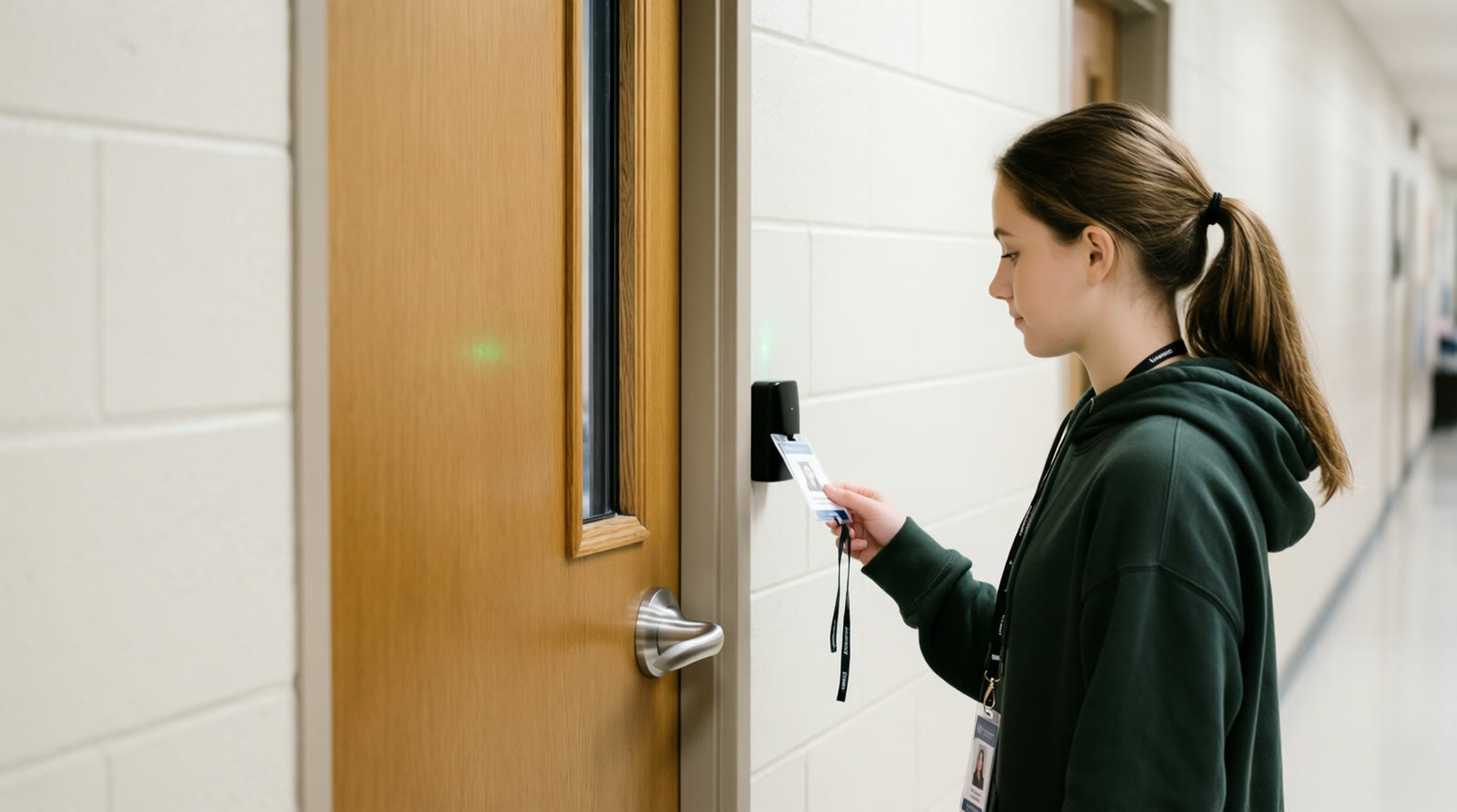
With ClassLock the door is locked from the hallway side by default and opens with a tap for anyone scheduled in that room, that period. The late student, the bathroom return and the nurse's pass all get in without a knock. The teacher never opens the door to find out who is there, and never needs a magnet to avoid doing so.
- The knock goes away for everyone who belongs in the room, which removes the reason doors are left unlocked.
- The window stops being the identification system, so it can be narrow, filmed or covered without making the door harder to use.
- Locked during passing time too. Florida and Utah exempt the minutes between classes; a credentialed door does not need to.
- No key, no step, no hallway. Lockdown comes from the office or the panic alert; the inside lever always opens.
- The sensor keeps the log of propped doors and denied taps, so compliance is measured rather than assumed.
Limits: a student with a legitimate credential for that room still gets in, and a stranger knocking still depends on the teacher looking first. Glass still needs film and a hard corner.
Keep the lock. Lose the knock.
A ten‑door pilot shows what a locked‑when‑occupied rule looks like when nobody has to answer the door.